Dead Air, Living Memory: What America's Abandoned Radio Towers Still Have to Say
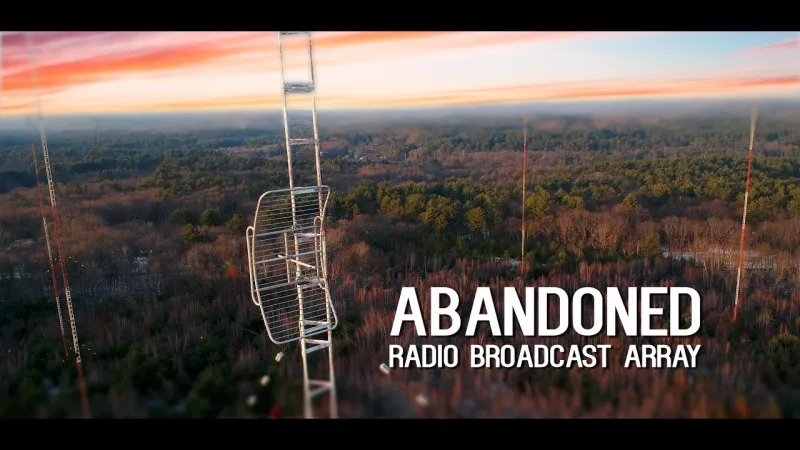
Photo: abandoned radio broadcast tower rural America overgrown, via i.ytimg.com
Somewhere outside Tulsa, Oklahoma, there's a rusted transmission tower standing in a field that hasn't broadcast a single watt since 1987. The building at its base — a cinder block shed, really — still has a console inside. Faders frozen in position. A clock stopped at 2:14. A coffee mug on the shelf with a station call sign printed on it, the glaze cracked but the logo still readable. Nobody locked the door. Nobody thought to.
This is what the end of independent radio actually looks like. Not a dramatic shutdown, not a formal archive, just — silence. And then weeds.
There are hundreds of sites like this scattered across the American landscape, remnants of a broadcast ecosystem that peaked somewhere around the mid-1970s before deregulation, consolidation, and eventually digital media systematically gutted it. What's left behind isn't just junk. For a growing community of collectors, historians, and signal obsessives, these abandoned infrastructures are primary sources — physical documents of a media culture that never got a proper obituary.
The Bones of the Broadcast Age
The Federal Communications Commission still maintains records on every station license ever issued in the US, which means you can trace a signal's entire lifespan — from its first licensed frequency to the date its license lapsed — with a few hours of archival work. What those records can't tell you is what happened to the building. Or the gear. Or the recordings.
That's where people like independent researcher and radio archivist Donna Felch come in. Felch has spent the better part of a decade documenting defunct stations across the Midwest, photographing equipment, cross-referencing FCC logs with local property records, and occasionally convincing landowners to let her inside. She estimates that maybe 30 percent of the sites she visits still have functioning or near-functioning equipment on premises.
"Most of it isn't valuable in any commercial sense," she's noted in correspondence shared in hobbyist forums. "But a working Gates console from 1963 is a historical artifact. It tells you exactly what a broadcast operation looked like at that moment in American media. That's not nothing."
The economics of why these stations closed tend to follow predictable patterns. The 1996 Telecommunications Act removed most of the ownership caps that had previously limited how many stations a single company could control in a given market. Larger operators swept in, bought up licenses, automated programming, and simply abandoned physical infrastructure that didn't fit their consolidation plans. Small-market independents that couldn't compete on ad revenue folded quietly. Their towers stayed up because taking them down costs money.
Frequencies That Won't Quit
Here's the part that genuinely unsettles people who spend time in this space: some of those dead frequencies aren't entirely dead.
Intermodulation interference, equipment left in low-power standby states, even atmospheric anomalies can cause old frequencies to briefly resurface — carrying fragments of signal that feel, to anyone scanning with a shortwave receiver, like transmissions from another era. This phenomenon has its own informal name in hobbyist circles: ghost signals. And while the explanations are almost always mundane, the experience of catching one isn't.
A collector in rural Georgia posted audio to an online forum two years ago of what appeared to be a partial broadcast — music, then a voice, then static — on a frequency that had been officially dark since 1991. The clip circulated widely. The consensus explanation was a combination of equipment bleed from a nearby active station and atmospheric ducting. But the clip itself, whatever its origin, sounded like a transmission from somewhere else in time.
That kind of ambiguity is part of what makes this corner of media archaeology so compelling. It's not nostalgia exactly — it's something more like forensics.
The Tape Hunters
If the towers are the skeleton of defunct radio, the recordings are the nervous system. And an enormous amount of mid-century American broadcast audio still exists on physical media — reel-to-reel tapes, acetate discs, even wire recordings — sitting in storage units, attics, and the back rooms of former station buildings.
The Internet Archive has become one of the primary repositories for this material as collectors digitize and upload what they find, but the volume of what remains undiscovered is genuinely difficult to estimate. Oral historians who work in this space talk about the "tape ceiling" — a point beyond which the degradation of acetate and magnetic tape will outpace the capacity to digitize it. That ceiling, by most accounts, is closer than it looks.
What's already been recovered tells a specific story about American media culture that the official history tends to flatten. Independent stations, particularly those serving rural markets or Black communities in the South and Midwest, were often the only places where certain kinds of music got played, certain political conversations got aired, certain voices got amplified. When those stations folded, that record — that daily, living archive of a community's media life — went with them. Unless someone saved the tapes.
In Memphis, a local preservation group has been working with the estate of a former station owner to catalog several hundred hours of recordings from a soul and R&B-focused independent that closed in 1979. Some of the recordings include live in-studio performances that exist nowhere else. Others are just air checks — routine recordings stations made of their own broadcasts for quality control — but even those capture something irreplaceable: the texture of a specific moment in a specific place, unmediated.
What the Silence Is Telling Us
The economic forces that killed independent broadcasting didn't just reshape the media landscape — they erased local specificity at a scale that's hard to fully reckon with. Consolidated, nationally programmed radio sounds the same in Phoenix as it does in Pittsburgh. That uniformity was a business decision, not a cultural one. And what was lost in the process was the accumulated strangeness of hundreds of small operations doing things their own way, for their own audiences, on their own terms.
The people hunting through abandoned towers and digitizing old tapes aren't trying to romanticize that era. A lot of those stations were poorly run, financially unstable, and operating under FCC rules that excluded entire communities from the airwaves. The history is complicated. But the artifacts are real, and they're disappearing.
Every corroded console left in a cinder block shed in Oklahoma is a data point. Every tape that gets digitized before it degrades is a vote against the version of history that only remembers what survived commercially. And every ghost signal that drifts across a dead frequency, whatever its actual source, is a reminder that the broadcast age didn't end cleanly.
It just went quiet. And quiet, it turns out, isn't the same as gone.