No Tower, No License, No Record: The Listeners Mapping Broadcasts That Officially Never Happened
The FCC's public database is comprehensive. It covers licensed AM and FM broadcasters, experimental stations, temporary authorizations, and historical records going back decades. It is, by every official measure, the authoritative record of what has broadcast and what has not in American airspace.
A growing community of radio listeners would like a word about that.
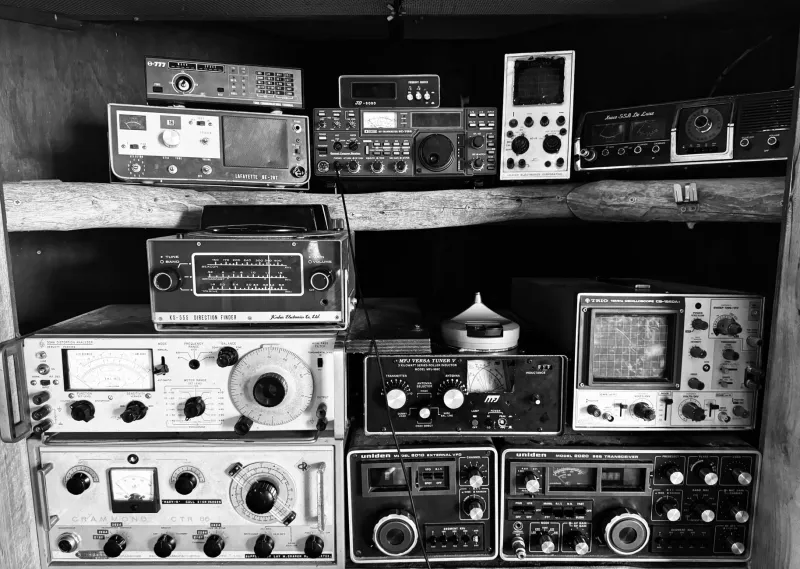
Scattered across the country — in converted garages in rural Tennessee, in apartment bedrooms in Chicago, in a surprisingly well-equipped listening post in a retired schoolteacher's basement in central New Mexico — are individuals who have spent years maintaining detailed logs of transmissions from stations that appear nowhere in that database. No call letters. No tower coordinates. No filing history. Nothing.
Just voices, coming from somewhere, heard by enough separate people in enough separate locations that the community has stopped calling them anomalies and started calling them something else: evidence.
The Archive With No Official Home
The project doesn't have a formal name, though various corners of the community use different terms for it. Some call it the shadow register. Others refer to it as the phantom log. What it amounts to is a collectively maintained, continuously updated catalog of broadcasts that listener testimony alone supports — cross-referenced by frequency, time, geographic reception range, and audio content description.
The methodology is more rigorous than it might sound. Entries require corroboration from at least three independent listeners in different locations before they're added to the shared record. Timestamps are standardized to UTC to eliminate time zone ambiguity. Listeners are asked to describe audio content in specific rather than interpretive terms — not "it sounded like news" but "male voice, measured cadence, referenced specific US highway numbers and weather conditions."
"We're very aware that this looks insane from the outside," said one of the project's informal coordinators, a woman in her sixties who asked to be identified only as Vera. "We're also very aware that the documentation we have is, by any reasonable standard, substantial. Those two things coexist and we've made our peace with it."
What the Logs Actually Describe
The entries in the phantom log don't follow a single pattern, which is part of what makes the project interesting and part of what makes it difficult to dismiss as a single shared delusion. Some entries describe what sounds like conventional AM-era programming — music, weather, agricultural reports — broadcasting on frequencies that haven't been in active use for decades. Others document shortwave signals with content that sounds contemporary: references to current events, modern vernacular, production values that suggest digital recording equipment.
A cluster of entries from the late 2010s describes a signal received consistently in the upper Midwest on a frequency sitting between two licensed stations. Thirty-seven separate listeners logged it across a period of about eight months. The content, according to their descriptions, was a nightly program of folk music interspersed with what several listeners described as "public service announcements that didn't correspond to any known organization." Then it stopped. No farewell broadcast, no sign-off. Just gone.
The FCC has no record of anything broadcasting on that frequency during that period.
"There's a version of this where it's a pirate station that was careful enough to never get caught," said one listener who contributed multiple entries to that cluster. "I'm comfortable with that explanation. I just want the record to reflect that it existed, whatever it was."
The Validation Problem
The community's biggest internal debate isn't about whether these broadcasts are real. Most participants have heard something they can't explain and that's what brought them here. The debate is about how to establish credibility for their documentation in a world that has no institutional framework for taking it seriously.
Skeptics — and there are genuine skeptics within the community, not just outside it — point to several problems. Listeners can misidentify frequencies, particularly in crowded band conditions. Descriptions of audio content are subjective and memory is unreliable. The corroboration requirement, while sound in principle, relies on a self-selecting group of people who are already inclined to believe unusual things about the radio spectrum. Confirmation bias doesn't disappear just because multiple people share it.
Vera acknowledges every one of these objections without conceding the broader point. "We know the weaknesses. We've written them down. They're part of the documentation." She paused. "What we're asking is not for anyone to believe us. We're asking for someone to explain the entries we can't account for. There's a difference."
What the Gaps in the Official Record Suggest
Here's the thing about the FCC database: it's comprehensive for what it was designed to capture. Licensed commercial and noncommercial broadcasters. Experimental stations that applied for authorization. Operations that wanted to exist within the regulatory framework.
It was not designed to capture everything that has ever transmitted. Military communications, government experimental programs, and Cold War-era intelligence broadcasts operated on domestic frequencies without public documentation. Some of these programs have been partially declassified; others remain opaque. The possibility that some phantom log entries represent the tail end of programs that were never meant to be public — still running on inertia or maintenance schedules long after their original purpose dissolved — is not, strictly speaking, impossible.
It's also not something anyone in an official capacity is likely to confirm.
"The gaps in the official record are the official record," said one source with a background in broadcast regulatory history who reviewed a sample of the community's documentation. "There are frequencies and time periods where I genuinely cannot tell you what was happening. The FCC's records from certain eras are incomplete. Whether that incompleteness explains what these listeners heard, I have no way of knowing."
Frequencies for the Few
What the phantom log community has built, whatever else you want to say about it, is a counter-archive. A parallel record. A document of the American broadcast landscape assembled entirely from the testimony of people who were paying attention when, apparently, no one official was.
They're not trying to prove anything supernatural. They're not, for the most part, making claims about government conspiracies or hidden transmitters or anything that requires extraordinary explanation. They're doing something quieter and in some ways more subversive: insisting that what they heard was real, writing it down carefully, and refusing to let the absence of official documentation be the final word.
Vera has been adding to the log for nine years. She estimates the project now contains entries from over four hundred individual listeners across forty-three states. She keeps her own copy on a hard drive that she backs up weekly.
"If a station broadcasts and no one with a license hears it," she said, "does it make a sound?"
According to her logs: yes. Frequently. Often after midnight, somewhere in the 40-meter band, in a voice that nobody can quite place.