One Man's Static: The Strange, Documented Obsession of a Radio Believer Nobody Could Debunk
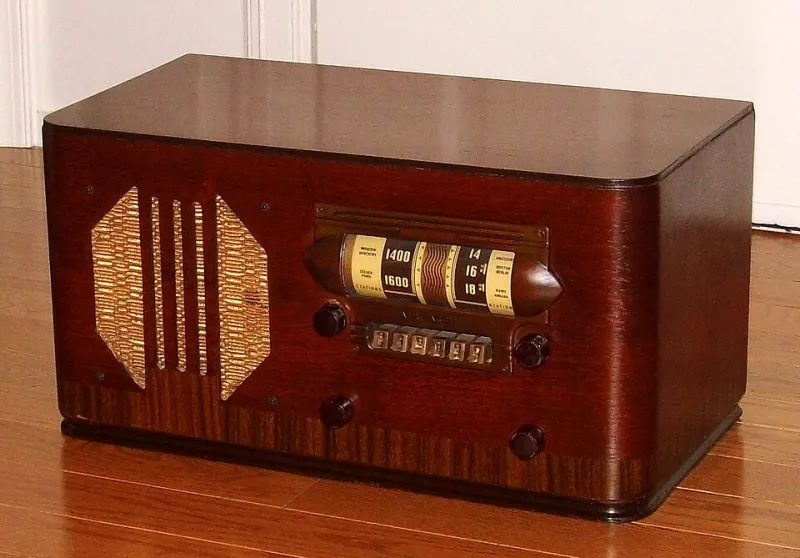
Photo: Joe Haupt from USA, CC BY-SA 2.0, via Wikimedia Commons
There's a particular kind of loneliness that comes with receiving a signal nobody else can confirm. You heard it. You wrote it down. You have timestamps, frequencies, even partial call signs. And yet every engineer you show your notes to gives you the same slow, careful look — the one that means we're not sure what you're dealing with, but it isn't this.
That was Harlan Creed's life for roughly four years in the 1970s. And depending on how you read the surviving documentation, he was either chasing a genuinely anomalous transmission or building a cathedral out of interference.
The Notebooks
Creed was a former telephone lineman living outside Hazard, Kentucky, who had been tinkering with shortwave equipment since the late 1950s. By most accounts from neighbors and local newspaper coverage from the era, he was methodical, quiet, and considered reasonably credible in amateur radio circles — not the type to fabricate. So when he started logging what he described as a pirate broadcaster operating somewhere in the 3.5 to 4 MHz range, people initially took him seriously.
His notebooks — seventeen of them, later donated to a small regional archive in eastern Kentucky — detail transmissions he received between 1972 and 1976. The content he transcribed was strange: fragments of what sounded like political commentary, occasional music he couldn't identify, and a recurring voice he referred to only as "the Operator." He noted signal strength, atmospheric conditions, time of day, and what kind of interference was present. It reads less like a conspiracy theorist's journal and more like a meticulous field log.
The problem was that nobody else in his region — or anywhere else, as far as anyone could determine — ever heard the same thing.
The Investigators Who Showed Up
Word got around, as it does. By 1974, Creed had connected with a loose network of shortwave hobbyists and at least two individuals with backgrounds in electrical engineering who were curious enough to make the drive out to Hazard. What they found was a man with legitimate equipment, a clean antenna setup, and a very specific claim he wasn't willing to soften.
One of those investigators, a man referenced in Creed's notebooks only as "R. from Cincinnati," spent three nights at Creed's property with his own receiver tuned to the same frequencies. He heard nothing unusual. His notes, which Creed apparently copied into his own journal, describe the signal environment as "unremarkable" and "consistent with normal band noise for the region and season."
Creed's response, also recorded, was patient and precise: The signal doesn't come every night. It comes when conditions are right and when the Operator chooses to broadcast. You can't schedule it.
That line is worth sitting with. It's either the statement of someone who understands how irregular pirate broadcasting actually works — and genuine pirate stations of that era were notoriously inconsistent — or it's a perfect unfalsifiable defense. Maybe both.
What the Psychology Actually Says
The easy interpretation is apophenia — the very human tendency to detect patterns and meaning in random data. White noise is genuinely rich with false signals. The brain, especially one that wants to hear something, will assemble phonemes from static, rhythms from interference, voices from the gap between frequencies. It's not delusion in the clinical sense. It's the auditory system doing exactly what it evolved to do, just pointed at the wrong input.
But here's where Creed's case gets more interesting than a simple cautionary tale about pattern recognition: some of what he transcribed was verifiable. Not the mysterious Operator, not the unidentifiable music — but specific references to news events that were accurate to within a day or two of when he logged them. Researchers who later examined the notebooks noted at least a dozen instances where his transcriptions aligned with real broadcasts from known sources.
The most charitable reading is that Creed was receiving fragments of legitimate transmissions — news radio, maybe some international shortwave — and unconsciously weaving them into a coherent narrative around a fictional central broadcaster. The less charitable reading is the same thing, just described less kindly.
What neither reading fully explains is the level of detail. The Operator had recurring verbal tics that Creed documented across multiple entries. There were inside references to previous broadcasts. There was, in other words, continuity — and continuity is genuinely hard to fake across four years of sporadic entries without either a real source or a deliberate fiction.
The Signal Void Problem
Here's the thing about signals at the edge of detectability: they exist in a space where the tools we use to verify them are often the same tools that could be generating them. Creed's receiver was good, but it wasn't laboratory-grade. The frequencies he was monitoring were genuinely crowded with atmospheric bounce, skip propagation from distant stations, and the kind of spectral debris that shortwave bands accumulated before digital filtering cleaned things up.
Pirate broadcasting in the 1970s was also real and widespread enough that dismissing his claim outright would have been its own kind of bias. Operators running illegal stations in that era were specifically designed to be hard to locate and impossible to verify. The FCC was actively hunting some of them. A good pirate didn't leave a clean trail.
So you have a man with real equipment, real skills, and real documentation, reporting a real category of thing that genuinely existed — just in a form nobody else could find. The signal void between "this happened" and "this was constructed" is exactly where Creed lived for four years, and it's exactly where his case still sits.
What Happened to Creed
He stopped logging in 1976. His final notebook entry is brief and doesn't explain the cessation: The Operator has gone off the air. I don't know if permanently. I'll keep listening.
Creed died in 1991. The notebooks sat in a family member's possession for over a decade before being donated to the archive. There's no evidence he ever found anyone who shared his experience, and no evidence the transmissions were ever traced to a source.
What's left is seventeen notebooks, a question without a resolution, and the particular frequency that exists between genuine anomaly and constructed meaning — which, if you've spent any time in the margins of American culture, you'll recognize as one of the most occupied spaces there is.
Some signals only exist for the person receiving them. That doesn't necessarily make them less real. It just makes them harder to share.