47 Days of Static: The Mystery Broadcast That Turned a Small Town Into True Believers
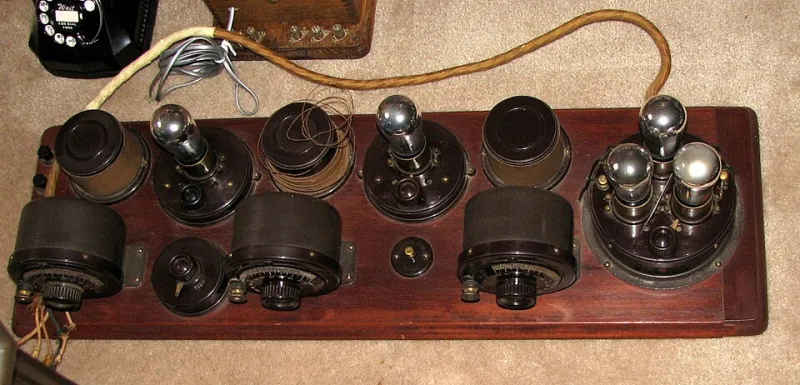
Photo: Joe Haupt from USA, CC BY-SA 2.0, via Wikimedia Commons
There's a particular kind of madness that comes from almost understanding something. Not the frustration of total ignorance — that's clean, manageable. No, this is the specific torment of a signal that's almost coherent, a voice that's almost saying your name, a broadcast that feels like it was made for you and you alone but refuses to confirm it.
That's what a small community in the rural Midwest got, starting on a Tuesday in late October and ending — without ceremony, without explanation — exactly 47 days later. What they were left with was a handful of degraded cassette recordings, a devoted local mythology, and a question that crowdsourced investigators are still poking at three decades on.
Signal Void has been sitting with this one for a while. It's the kind of story that resists clean summaries.
The Signal Arrives
The first reports came from truck drivers. Two or three of them, independent of each other, mentioned picking up something strange on the AM dial while passing through the area — a low, looping broadcast that didn't match any registered station in the region. The content was odd: fragments of music, long stretches of what sounded like processed speech, occasional tones that some listeners described as "organized" and others described as "wrong."
Within a week, locals with home receivers were catching it too. The signal had a narrow range — you could drive maybe twelve miles in any direction before it faded — but inside that radius it was remarkably consistent. Same general time window each evening, roughly 9 PM to just past midnight. Same strange texture. Same sense that something deliberate was happening just out of reach of comprehension.
A retired electrical engineer named Harold, who had lived in the area for decades, started keeping a log. He wasn't the only one. By the end of the first two weeks, at least a dozen households were independently recording whatever came through, comparing notes at the local diner over coffee that got cold while people argued about whether a particular recurring tone sequence was Morse code, a musical interval, or just interference artifacts.
It wasn't Morse code. Nobody could agree on much else.
What the Tapes Actually Contain
The recordings that survived — and survival here is generous, since most were made on consumer-grade cassettes that have since degraded significantly — reveal a broadcast that is genuinely difficult to categorize. There are passages that sound like shortwave number station transmissions, the kind that Cold War enthusiasts have been obsessing over for decades. There are stretches of what might be music, heavily processed, with rhythms that don't quite resolve. And then there are the voice segments.
The voice, or voices — listeners have never agreed on whether it's one speaker or several — speaks in English but in a register that's hard to pin down. Not robotic, not quite human-casual. Someone once described it as "a person reading something they wrote a long time ago and no longer fully believe." The content, where it's been transcribed, is fragmentary: references to geographic coordinates that don't map to anything recognizable, what might be dates presented in a non-standard format, and recurring phrases that feel like they should mean something specific but dissolve under direct analysis.
The most frequently cited segment, the one that tends to bring new investigators into the fold whenever someone posts about it online, is a roughly 40-second passage in which the voice appears to describe "a frequency that exists only when it's being listened to." Whether that's poetry, technical jargon, or a glitch in the recording is, predictably, a matter of fierce debate.
The Investigation Becomes the Thing
Here's where the story gets interesting in a way that reaches beyond the signal itself. What happened in that community over those 47 days — and in the years after — is essentially a prototype for the kind of crowdsourced mystery-solving that the internet later industrialized.
Before Reddit threads and Discord servers, these people had phone trees and bulletin board postings at the hardware store. They divided up recording duties. They cross-referenced logs. A high school physics teacher ran informal spectrum analysis using equipment borrowed from the school lab. Two amateur radio operators attempted triangulation and came up with conflicting results that they argued about for years afterward without resolution.
When the signal stopped — no fade, no final transmission, just gone after the 47th night — the community didn't dissolve. If anything, the absence intensified things. The investigation shifted from "what is this" to "what was this," which is a fundamentally different and more durable question. Theories accumulated. A pirate broadcaster running an experiment. A military installation testing something. A lone operator, possibly disturbed, possibly brilliant, transmitting from a vehicle or a temporary setup that was never meant to be permanent.
None of it was ever confirmed. The FCC, contacted by at least one resident, apparently opened a file that went nowhere.
Why We Still Need This
Decades later, the signal has found new life online, the way these things do. Scanned copies of Harold's logs circulate in forums dedicated to anomalous radio phenomena. The degraded tapes have been digitized, filtered, analyzed with software that didn't exist when they were made. New listeners bring new frameworks — ARG hunters, number station archivists, experimental music people who think the processed audio segments might be something worth recovering.
And still nothing is solved. Which is, if you squint at it right, kind of the point.
We talk a lot about how the internet mapped everything, made everything findable, collapsed the distances that used to let mysteries breathe. And that's mostly true. But the hunger for unexplained signals — for transmissions that seem to mean something without yielding that meaning — hasn't gone anywhere. If anything, it's more acute. When everything has a Wikipedia page and a subreddit and a debunking thread, the things that resist explanation become precious.
The 47-day broadcast resists. It has resisted for thirty-plus years. The community it touched has largely moved on in the practical sense — people died, people left, the diner where the logs got compared closed sometime in the 2000s — but the signal itself, in its degraded, digitized afterlife, keeps pulling people in.
The Frequency That Listens Back
There's a version of this story where the mystery gets solved. Where someone, somewhere, has a box of documentation in their attic that explains exactly what the broadcast was, who made it, why it ran for precisely 47 days and not 46 or 48. That version is probably out there. Most mysteries have a mundane answer lurking somewhere in the paperwork.
But the people who've spent time with the tapes, who've mapped the tone sequences and argued over the voice segments, seem mostly uninterested in that version. Not because they've given up, but because the investigation itself became something — a community artifact, a shared language, a reason to keep listening.
Which might be what the broadcast was for all along. Or it might just be static that got lucky.
Signal Void doesn't resolve things. We just tune in.