Tuned In, Locked Out: The Amateur Radio Obsessives Who Accidentally Became America's Shadow Intelligence Network
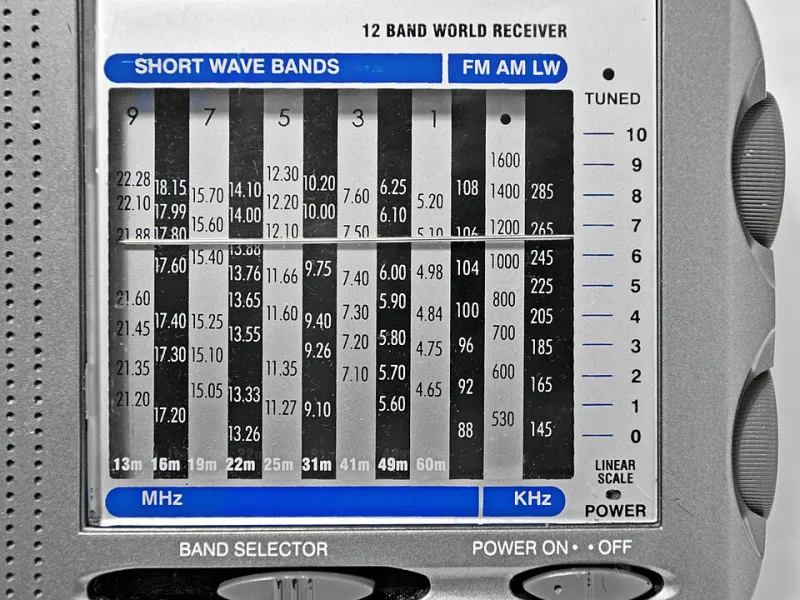
Photo: Multicherry, CC BY 4.0, via Wikimedia Commons
There's a specific kind of 2 a.m. quiet that shortwave listeners know better than most people. The house is dark, the neighborhood is down, and somewhere between 5 and 20 megahertz, a voice is reading numbers in a language you might not speak, in a cadence that feels almost liturgical. Five digits. Pause. Five digits. Pause. Then silence, or static, or a folk melody that doesn't belong anywhere near the frequencies it's occupying.
This is the world of numbers stations — and for a particular strain of American hobbyist, it became something closer to a calling than a hobby.
The Signal That Wasn't Supposed to Be There
Numbers stations have been documented since at least World War I, though their Cold War proliferation is what cemented them in the cultural imagination of anyone paying attention. The premise is deceptively simple: a shortwave transmitter broadcasts strings of numbers, letters, or phonetic code groups, typically read by a synthesized or heavily processed voice, sometimes preceded by a musical identifier. The intended recipient — presumably a field operative somewhere with a one-time pad — decodes the message. Everyone else hears noise.
The U.S. government has never officially confirmed operating numbers stations. Neither has the UK, Russia, Cuba, or most of the other nations credibly linked to them. This is, in its own way, a kind of performance. The signals are real. The transmitters are real. The logistics required to maintain global shortwave infrastructure are not cheap or accidental. The official silence isn't ignorance — it's policy.
Which is exactly why the hobbyist community that formed around logging these transmissions became, without intending to, a distributed intelligence operation running parallel to the one nobody was admitting to.
Basement Antennas and Accidental Archives
By the 1980s, a network of shortwave enthusiasts across the United States had developed informal systems for sharing what they were hearing. Pre-internet, this meant newsletters, telephone trees, and in-person meetups at hamfests — those sprawling amateur radio flea markets that still happen in parking lots across the Midwest and Mid-Atlantic. Listeners compared logs. They mapped transmission schedules. They tracked which stations appeared after major geopolitical events and which went dark when diplomatic relationships shifted.
The Conet Project, a landmark 1997 compilation that gathered recordings of numbers stations from collectors worldwide, gave the broader public its first real catalog of what these listeners had been archiving. Four CDs. Hundreds of recordings. Voices from stations with names like the Lincolnshire Poacher, Cherry Ripe, and the iconic Atencion — the Cuban HM01 station that became particularly significant after it was linked to the prosecution of a Cuban spy ring in the United States in the late 1990s.
That prosecution was one of the only times a government acknowledged, however obliquely, that the signals these hobbyists had been logging were exactly what they looked like. A federal court accepted recordings made by amateur listeners as evidence. The signals were real. The espionage was real. The hobbyists had been right.
What the Logs Actually Show
The community that formed around numbers station monitoring — centered in the U.S. around groups like the Spooks mailing list and later online forums dedicated to signals intelligence — built something that functions less like a hobby archive and more like a longitudinal study in covert communication infrastructure.
Transmission logs stretching back decades show patterns that correlate with documented historical events in ways that are difficult to dismiss as coincidence. Stations increased broadcast frequency during the lead-up to known intelligence operations. Others went silent in ways that tracked with diplomatic expulsions. A few transmitted on schedules so precise that hobbyists were able to predict broadcast windows weeks in advance — which raises obvious questions about who else was using that predictability.
What makes the American hobbyist contribution particularly interesting is geography. The U.S. sits in a sweet spot for shortwave reception from multiple transmission regions simultaneously. A well-equipped listener in, say, rural Virginia or the flat reception-friendly expanses of the Great Plains can log signals originating from Cuba, Eastern Europe, and East Asia in a single evening session. The distributed nature of the hobby meant that collectively, American listeners were covering more ground than any single monitoring operation could reasonably manage.
The Signal Void at the Center of It All
Here's the part that doesn't resolve neatly: nobody fully knows what most of these messages said.
One-time pad encryption, used correctly, is mathematically unbreakable without the pad itself. The hobbyists logging these transmissions were capturing the carrier, not the content. They knew something was being communicated. They knew roughly who was probably communicating it and why. But the actual intelligence — the names, the instructions, the dead drop locations, whatever operational detail was moving through those frequencies — remained inaccessible. The void at the center of the signal was, by design, absolute.
This is the strange epistemic position these listeners occupied: they had assembled significant circumstantial evidence of covert government activity while remaining permanently locked out of the thing itself. They were witnesses to a conversation they could never hear.
Some found this frustrating. Others found it, honestly, more interesting than actual decryption would have been. The mystery was the point. The gap between what could be observed and what could be known was where the entire subculture lived.
Still Transmitting
Numbers stations haven't disappeared. They've adapted. Digital modes have supplemented or replaced some analog voice broadcasts. Shortwave infrastructure has contracted globally, but the signals that remain tend to be the ones someone still finds worth maintaining. Listeners who've been at this for thirty or forty years report that the community has gotten smaller but arguably more sophisticated — better equipment, better software-defined radio setups, better tools for signal analysis.
The archive they've collectively built remains one of the more remarkable examples of distributed citizen documentation in American cultural history, even if it's never been framed that way. No funding. No institutional support. No official acknowledgment that what they were recording was real or significant. Just people with antennas, logbooks, and a tolerance for long nights spent listening to voices read numbers into the dark.
The government kept its secrets. The hobbyists kept their logs. And somewhere in the gap between those two archives, the actual history of Cold War and post-Cold War covert communication is sitting, partially assembled, waiting for a context that may never fully arrive.
That's the thing about signals that were never meant for you. You can receive them. You can document them. You can spend decades building a picture of what they represent.
You just can't be sure you're reading it right.