Keepers of the Lost Signal: The Shadow Archivists Cataloging Broadcasts That Never Officially Happened
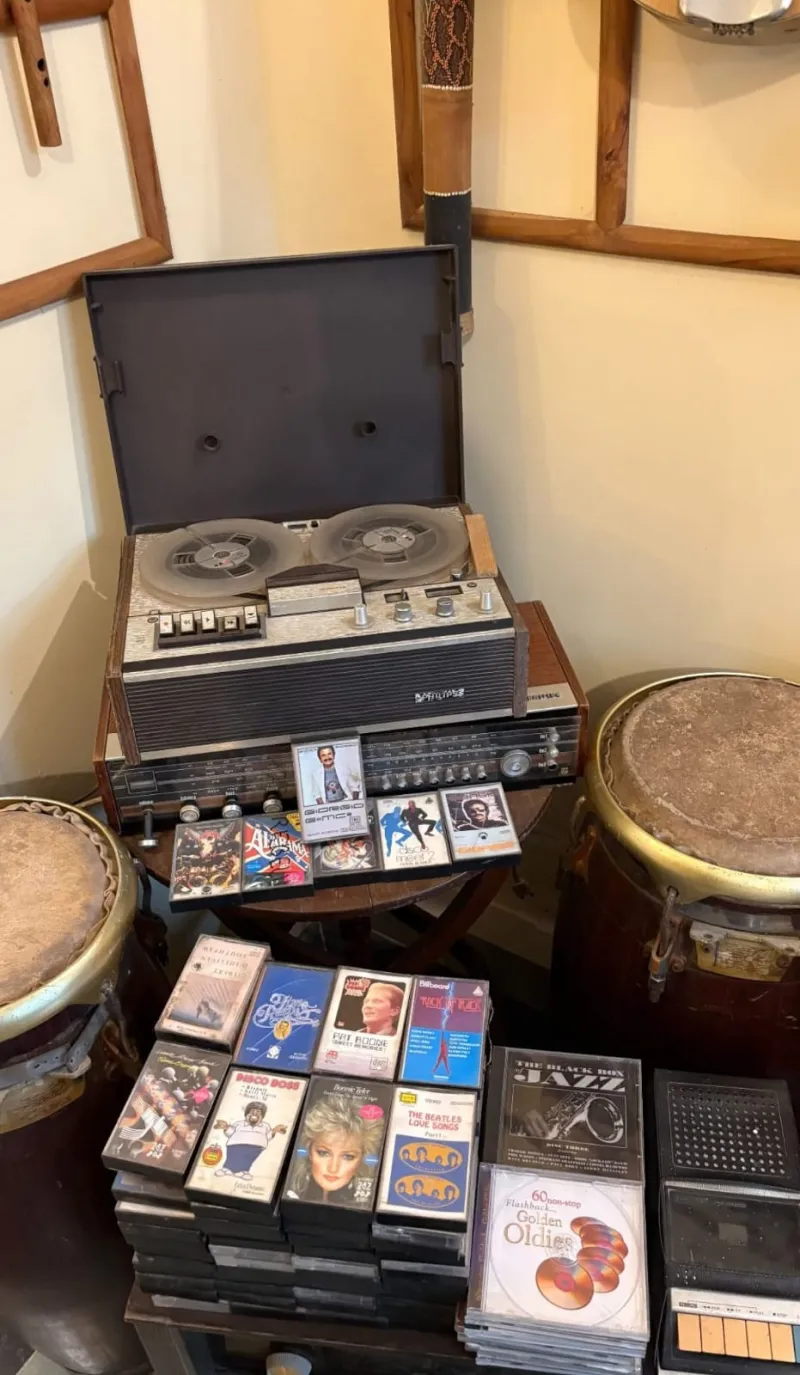
Photo: Himesh23, CC BY-SA 4.0, via Wikimedia Commons
There's a guy in rural Ohio — goes by the handle Ferrite_77 online — who has roughly 4,000 hours of recorded radio transmissions stored across a mix of reel-to-reel tapes, digitized .wav files, and one ancient DAT deck he refuses to retire. Most of what he's collected has no official documentation. No FCC filing. No broadcaster on record. No explanation.
He's not alone.
Across the United States, a loose, informal community of radio enthusiasts has quietly spent decades doing something that no government agency, university, or media institution has bothered to do systematically: recording, cataloging, and preserving the signals that fall through the cracks of the official broadcast record. They call themselves collectors, archivists, monitors — the terminology varies — but the work is essentially the same. Catch what's out there. Write it down. Keep it safe.
What they've accumulated is stranger and more significant than most people outside their circles would ever guess.
The Archive Nobody Asked For
The appeal of undocumented radio is hard to explain to someone who hasn't felt it. It's not just the mystery, though the mystery is real and persistent. It's more about the understanding that the electromagnetic spectrum is a kind of public commons that has always carried more traffic than anyone officially acknowledges. Commercial stations, amateur operators, military channels, government frequencies — those are the documented layers. Beneath and between them is something else entirely.
The collectors who've built these shadow archives tend to come from a few overlapping backgrounds. Some started as ham radio operators who got curious about signals that didn't fit any band plan they'd been taught. Others came up through the shortwave listening community of the '70s and '80s, when tuning in to international broadcasts was one of the few ways an American kid could hear a voice from East Berlin or Havana. A smaller contingent arrived from the numbers station obsession that exploded in the early internet era, when communities started pooling recordings and realizing the scale of what had gone undocumented.
What they share is a particular kind of patience. You can't rush this work. You sit with a receiver, you scan, you wait, and sometimes — not always, not even often — something comes through that doesn't fit any category you were expecting.
Cold War Residue
A significant portion of the most historically interesting material in these private collections dates to the Cold War era, roughly 1950 through 1991. This makes sense. The period was defined by communication systems designed specifically to be invisible to civilian monitoring — and yet civilian monitors caught a lot of it anyway.
Numbers stations are the most famous example. These shortwave broadcasts, consisting of a voice reading strings of numbers or letters in a flat, mechanical cadence, were almost certainly used to transmit encrypted messages to intelligence operatives in the field. The U.S. government has never officially confirmed operating them. Several other governments have maintained similar silence. And yet the recordings exist — thousands of hours of them, held in private collections that were never commissioned, never funded, and never formally recognized.
Ferrite_77 has what he believes are roughly 200 hours of numbers station recordings from the 1970s and '80s, sourced partly from his own monitoring and partly from tapes traded within the community over the years. Some of it has been cross-referenced with recordings held by collectors in Germany and the UK. The overlaps are illuminating. The same transmission, caught independently by listeners on different continents, confirms authenticity in a way that a single recording never could.
"There's a whole historiography here that just hasn't been written yet," he told Signal Void in a recent exchange. "These recordings are primary sources. Actual evidence of communication systems that shaped the twentieth century. And they're sitting in people's basements."
The Contemporary Signal Problem
If Cold War material represents the historical core of these archives, the contemporary material is where things get genuinely strange.
Collectors monitoring the spectrum today report a range of signals that resist easy classification. There are the data bursts — short, high-speed transmissions that appear on various HF frequencies and seem to carry encoded information, though their origin and purpose remain unclear. There are what some in the community call "beacon networks," low-power signals that repeat at regular intervals with no obvious commercial or amateur purpose. And there are the occasional anomalies: signals that appear once, or for a brief period, and then vanish without explanation.
The challenge with contemporary undocumented signals is that the explanations are genuinely harder to pin down. During the Cold War, the landscape was shaped by a relatively small number of actors with known motives. Today, the possibilities are wider. Private intelligence contractors, corporate communication systems, experimental technology being field-tested, hobbyist projects that got out of hand — all of these are plausible sources for signals that show up in collector logs without any corresponding public documentation.
The community has developed its own informal protocols for evaluating new recordings. Cross-referencing with other collectors is standard practice. Technical analysis — looking at modulation type, frequency behavior, signal strength patterns — gets applied where possible. And there's a healthy culture of skepticism about extraordinary claims, partly because the history of radio has attracted more than its share of people who want mystery more than they want truth.
Distributed, Deliberately
One of the defining features of this archive — and probably the thing that makes it genuinely resilient — is that it doesn't exist in any single place. There's no central repository, no governing body, no single point of failure. Recordings live on personal hard drives, in cloud storage accounts, on physical media in closets and garages across the country. Metadata and catalog information gets shared through forums, mailing lists, and direct exchanges between trusted contacts.
This distribution is partly practical and partly philosophical. The community has no particular reason to trust institutions with their collections. The recordings document, in many cases, activities that official sources have denied or ignored. Centralizing the archive would mean trusting someone else to preserve it — and in a community built on the experience of watching things disappear from the official record, that's not a risk many collectors are willing to take.
There have been informal attempts to create more organized repositories. A few university libraries have expressed interest in certain collections over the years. Some material has found its way into publicly accessible digital archives. But the bulk of it remains distributed, held by individuals who've been doing this work quietly, without recognition, for decades.
What It Adds Up To
The question worth sitting with is what this distributed, unofficial archive actually represents as a body of evidence. The collectors themselves are cautious about overstating it. These are recordings, not interpretations. They document that signals existed; they don't always explain what those signals meant or who sent them.
But the act of preservation itself carries weight. Official histories are built from official records, and official records have a way of omitting the inconvenient and the embarrassing. What the collectors have assembled, imperfectly and without institutional support, is a counter-record — a set of evidence that the spectrum was always more crowded, more contested, and more revealing than the sanctioned version of events acknowledges.
Somewhere in Ohio, Ferrite_77 is probably scanning right now. Writing things down. Keeping them safe.
The signal doesn't care whether anyone's listening. But someone always is.