Before the Headline Drops: The Shortwave Oracles Who Say They Saw It Coming
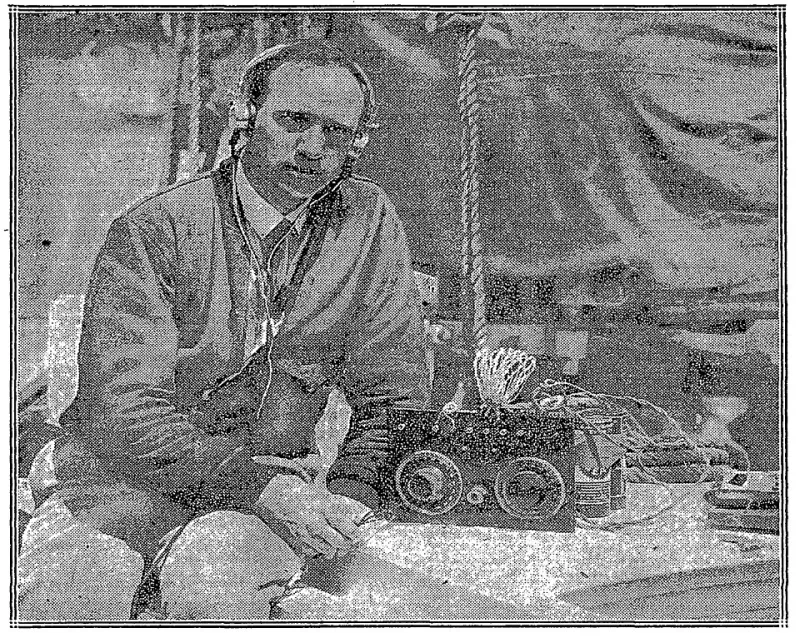
Photo: Wide World Photos, Public domain, via Wikimedia Commons
Somewhere in rural Tennessee, a man who goes by the handle Cassian_RX woke up at 3:14 a.m. on a Tuesday, shuffled to his radio shack, and logged an unusual spike in encrypted military traffic on a frequency cluster he'd been monitoring for eleven years. He noted it in a private forum. Forty-six hours later, a significant diplomatic incident broke in a region he'd flagged as "elevated tension." He didn't predict the specifics. He predicted the pressure.
"I don't call it prophecy," Cassian_RX told Signal Void over an encrypted message thread. "I call it pattern recognition. The spectrum doesn't lie. People lie. Institutions lie. Radio traffic doesn't know how to."
This is the world of the Frequency Prophets — a scattered, loosely affiliated subculture of shortwave monitors, signal analysts, and prepper-adjacent hobbyists who believe that the electromagnetic spectrum functions as a kind of early warning system for the planet. They're not fortune tellers. Most of them would bristle at the comparison. But they do believe, with a conviction that borders on religious, that if you listen long enough and carefully enough, the noise starts to tell you things the news cycle won't get to for another 48 hours.
What They're Actually Listening For
Understanding the Frequency Prophets requires a quick primer on what shortwave radio actually carries in 2024. Contrary to popular assumption, shortwave didn't die with the Cold War. Numbers stations still transmit — those eerie, repetitive broadcasts of spoken digits or tones that intelligence communities have used for decades to communicate with field agents. Military RTTY (radio teletype) traffic pulses across allocated and unallocated bands. Emergency management frequencies carry pre-alert traffic that never makes it to FEMA's public-facing systems. Weather buoys, maritime beacons, and ionospheric monitoring stations all contribute to a constant electromagnetic conversation that most people never hear.
The monitors aren't just listening to one thing. They're cross-referencing. A spike in encrypted naval traffic here, an unusual pattern on a civil defense frequency there, an anomalous burst from a known government installation — individually, these mean little. Aggregated and compared against historical baselines, the community argues, they form a picture.
"It's like watching the pressure drop before a storm," said a woman who monitors from a property outside Flagstaff, Arizona, and asked to be identified only as Mesa_77. "You're not seeing the storm. You're seeing the conditions that make the storm inevitable. Once you've watched it long enough, you start to feel when something's about to break."
The Case Files They Won't Let Go
The community maintains its own informal archive — logs, timestamps, forum posts, and cross-referenced signal data that members point to as evidence of their track record. The cases are compelling enough to make you pause, even if you arrive skeptical.
In 2019, several members flagged abnormal traffic patterns across Southeast Asian military frequencies in the weeks before a regional escalation that caught most Western media flatfooted. In early 2020, a cluster of monitors documented unusual activity on frequencies associated with Chinese civil and military infrastructure before COVID-19 had registered as a global story outside of niche infectious disease circles. And in 2023, at least three members of a private Discord server claim to have logged signal anomalies consistent with large-scale troop movement logistics before a conflict escalation that dominated headlines weeks later.
None of this is verifiable in any rigorous sense. The logs exist, but timestamps can be manipulated. Correlation, as the skeptics will remind you, isn't causation. And the community itself acknowledges a significant signal-to-noise problem: for every "hit," there are dozens of elevated-alert flags that never resolved into anything.
"We're not batting a thousand," Cassian_RX admits. "Nobody is. But our hit rate on genuine geopolitical pressure events is higher than I can explain away as coincidence. I've tried."
The Oracle Problem
Here's where it gets philosophically thorny. Even if these monitors are genuinely detecting real signals — and some of what they describe is, technically, accessible public spectrum — the interpretive layer is entirely human. And humans are extraordinarily good at finding patterns in noise. It's called apophenia, and it's the same cognitive mechanism that makes us see faces in clouds and conspiracies in coincidences.
Dr. Ellen Marsh, a cognitive scientist who has studied pattern recognition in hobbyist communities (and who asked that her institutional affiliation not be included), puts it plainly: "The shortwave monitoring community is doing something genuinely interesting. They're aggregating real data. The problem is that the framework for interpreting that data is self-reinforcing. A hit gets remembered and logged. A miss gets rationalized or forgotten. Over time, the community's confidence in its own predictive power grows independent of its actual accuracy."
The monitors are aware of this critique. Most of them have heard it. And most of them reject it — not dismissively, but with the particular stubbornness of people who believe they've seen something real that the mainstream framework isn't equipped to evaluate.
"Every new methodology looks like noise to the people invested in the old one," Mesa_77 said. "I'm not asking anyone to believe me. I'm asking them to sit with a receiver for six months and then tell me they don't notice things."
Who's Actually In These Networks
The demographic is more varied than the prepper stereotype suggests. Yes, there are off-grid survivalists with antenna farms and bunkers stocked for the collapse. But there are also retired military signals officers, former intelligence contractors, ham radio veterans, and a surprising number of people who stumbled in from the software-defined radio (SDR) hobbyist community and never left.
SDR technology — cheap USB dongles that turn a laptop into a broadband radio receiver — democratized spectrum monitoring in a way that's genuinely significant. A setup that would have cost thousands of dollars in the 1990s now runs under $50. This has flooded the community with new listeners, which has accelerated both the data collection and, critics argue, the pattern-matching noise.
The private forums and Discord servers where this community lives are invitation-only or require demonstrated technical knowledge to access. There's an informal vetting process, partly to keep out bad actors and partly to maintain a signal-to-noise ratio in the community itself — a meta-irony nobody seems lost on.
Reading the Void
Whether the Frequency Prophets are genuine early-warning analysts or elaborate architects of self-fulfilling belief systems, they represent something real about the current information moment. Mainstream media is slow, institutional, and increasingly distrusted. The official channels — government alerts, press briefings, network news — operate on timelines and incentives that don't always serve the people trying to understand what's actually happening.
In that gap, the spectrum becomes a kind of alternative text. Harder to read, easier to misread, but — to the people who've devoted years to it — more honest than anything with a byline or a broadcast license.
Cassian_RX logs off every session the same way, he says. He notes the time, the frequency, the traffic pattern, and a single-word assessment: quiet, elevated, or breaking.
The night we spoke, he logged it as elevated.
We'll see.